
Does defending from a knife really work?
Knife Defence: The Most Important Skill May Be Not Engaging at All
There is a problem with the term "knife defence".
It can create the impression that there is a reliable collection of techniques which, once learned, allows someone to safely deal with a knife attack.
The reality is very different.
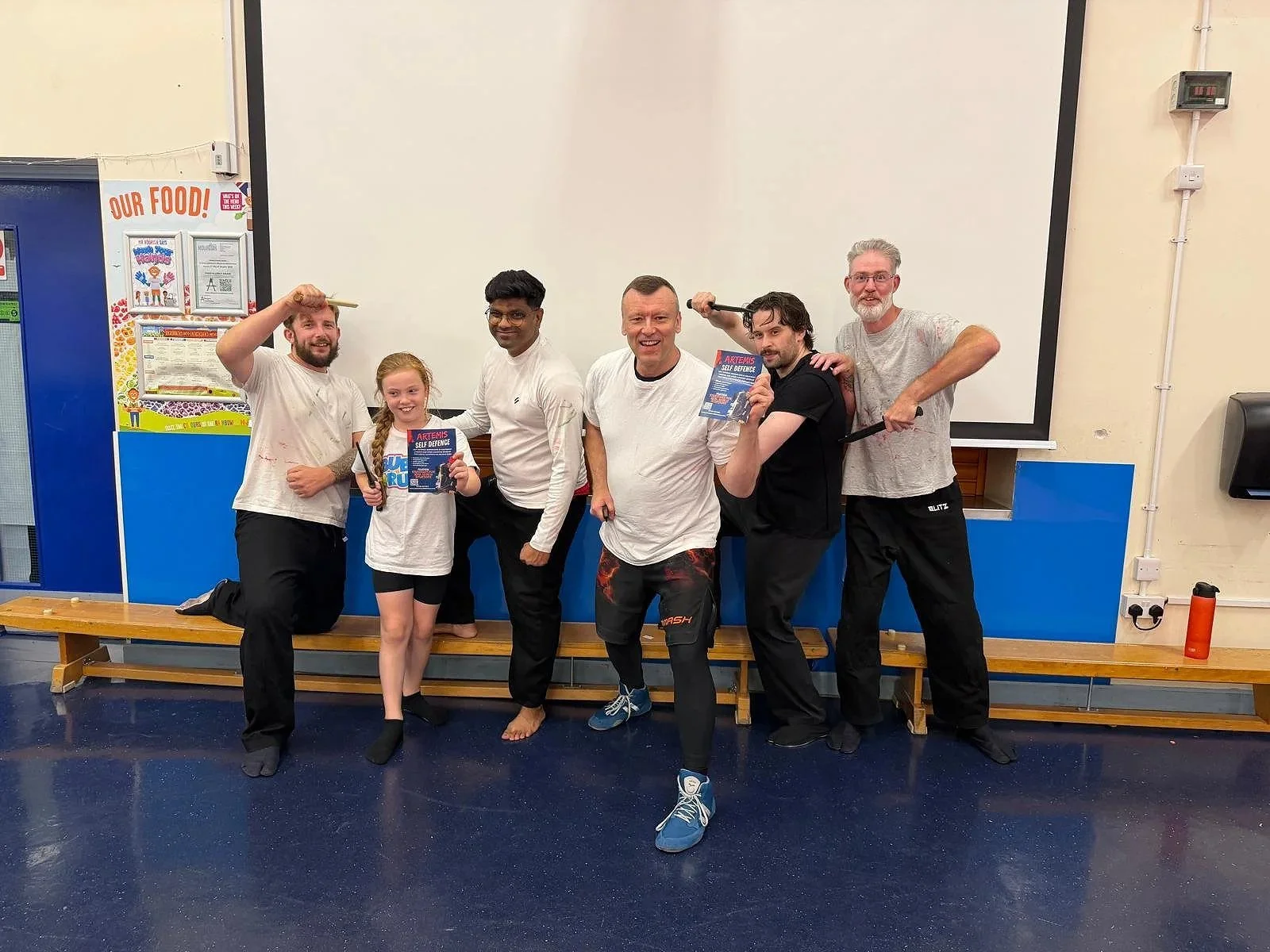
At a recent Artemis Self Defence workshop, we wanted participants to understand that reality before we started looking at any physical responses. The purpose was not to frighten people, but to remove some of the myths surrounding knife defence and replace them with a more realistic approach based around awareness, avoidance, distance, escape and survival.
We Started With Physics
We began with something slightly different: physics.
We discussed the differences between injuries produced by firearms and those produced by knives.
A projectile can carry considerable kinetic energy, expressed by the familiar equation:
KE = ½mv²
Velocity is squared, which helps explain why a relatively small projectile travelling at high speed can transfer significant energy.
We also discussed temporary cavitation, where energy transferred into tissue by some projectiles can temporarily displace and stretch tissue beyond the immediate path of the projectile.
A knife generally produces trauma differently. Rather than producing the same ballistic temporary cavity, it causes injury primarily through cutting and penetrating tissue directly along the path of the blade.
That does not make a knife less dangerous.
A relatively small blade can penetrate deeply enough to damage major blood vessels and vital organs. A wound that appears relatively small externally may therefore conceal significant internal injury.
This was an important starting point because knife defence should begin with an appreciation of what the weapon is capable of doing.
Knife Crime Is Not an Abstract Problem
The latest Office for National Statistics figures show that police in England and Wales recorded 48,774 offences involving a knife or sharp instrument in the year ending March 2026. Although this represented an 8% decrease compared with the previous year, it is still a substantial number of incidents. (Office for National Statistics)
The same statistics show that 44% of knife-enabled offences were categorised as assault with injury or assault with intent to cause serious harm, while another 39% involved robbery. (Office for National Statistics)
The seriousness of edged weapons is also apparent in homicide statistics. In the year ending March 2025, 205 homicides were committed using a knife or other sharp instrument, representing 39% of recorded homicides in the Home Office Homicide Index. (Office for National Statistics)
Hospital data provide another perspective. In the year ending March 2025, there were 3,508 NHS hospital admissions following assault with a sharp object in England and Wales. (Office for National Statistics)
These statistics reinforce something we repeatedly emphasise during our training:
A knife should never be treated casually.
Understanding How Knives Are Actually Used
After the theory, we moved onto the practical element.
We looked at some of the basic ways someone might use a knife, including different grips, angles of attack, thrusting and slashing movements.
But there was an important reason for doing this.
We were not trying to teach people how to knife fight.
We wanted participants to appreciate how fast, chaotic and unpredictable an edged-weapon assault can become.
Real violence does not necessarily resemble a martial arts demonstration.
An attacker may not present the knife conveniently in front of you and perform one committed attack before leaving their arm extended while you execute a multi-stage defence.
They may move.
They may change hands.
They may grab you with their other hand.
They may repeatedly thrust or slash.
You may not even realise immediately that a knife is involved.
That unpredictability is one of the reasons we should be extremely cautious about claiming that any particular technique is a guaranteed "knife defence".
Don't Engage With the Knife Unless You Have To
Perhaps the most important part of our approach is understanding that physical engagement with someone holding a knife should not be your first objective.
If someone produces a knife twenty feet away from you and you have a clear route of escape, attempting to close that distance so that you can perform a knife defence technique makes absolutely no sense.
Distance is an advantage.
If you can move away safely, move away.
If you can put a substantial barrier between yourself and the person, use it.
If you can get through a secure door, do so.
If the person is demanding property and surrendering that property provides a safe opportunity to disengage, your phone or wallet can be replaced.
The objective is not to prove that your training works.
The objective is to get home.
Physical intervention becomes relevant when safer options are unavailable, for example if escape is blocked or an attack is already taking place.
Even then, there is an important distinction between fighting the knife and trying to create an opportunity to escape from the person using it.
Our aim is not to stand there exchanging techniques with an armed attacker.
If physical action becomes unavoidable, the objective is to survive long enough to create an opportunity to disengage, move away and escape.
The Lipstick Knife Drill
We then carried out one of the most revealing exercises of the workshop.
Everyone put on a white T-shirt.
We used rubber training knives and applied lipstick to the edges and tips of the blades.
Participants then carried out controlled sparring.
The idea was simple.
Every lipstick mark on the white T-shirt represented somewhere the training knife had made contact.
Suddenly, knife defence became much less theoretical.
A technique might have felt successful, but when we stopped and examined the T-shirts, the evidence was there.
Cuts across arms.
Marks across the torso.
Contact around areas containing major blood vessels.
Multiple strikes that people had not even noticed occurring during the exchange.
And everyone got marked.
Every single person was "cut" or "stabbed".
Some of those simulated injuries might have represented relatively minor wounds.
Others were positioned where a real penetrating injury could potentially have been life-threatening.
That is an extremely valuable lesson.
You May Get Cut
This is something that is sometimes uncomfortable to discuss in martial arts.
There is no guarantee that someone defending themselves against a determined attacker armed with a knife will escape without injury.
Training should therefore not be based around pretending that we have discovered a perfect technique.
Instead, training should improve the things that may increase someone's chances of survival:
Awareness.
Recognising a developing threat early enough to act.
Distance.
Not unnecessarily allowing someone armed with a knife to get close.
Movement.
Being able to move rather than becoming fixed in position attempting complicated techniques.
Barriers.
Using the environment to make it harder for someone to reach you.
Decision-making.
Understanding when to disengage rather than allowing ego to draw you into a confrontation.
Escape.
Recognising that successfully getting away is a victory.
And finally, when there genuinely is no safer alternative:
Physical self-defence.
Not because it guarantees success, but because doing something may offer a better chance of survival than doing nothing.
Training Should Reduce Confidence in Fighting a Knife, Not Increase It
One of the strange things about good knife-defence training is that it should actually make you more reluctant to engage with a knife.
The more realistic the training becomes, the more obvious the danger becomes.
Our lipstick drill demonstrated this perfectly.
Even people with martial arts experience were being marked.
That does not mean training is pointless.
Quite the opposite.
It means training needs to have the correct objective.
We are not trying to produce people who believe they can confidently fight someone armed with a knife.
We want people who understand the danger early enough to make better decisions.
Sometimes the best knife defence is noticing something is wrong and crossing the road.
Sometimes it is leaving a confrontation before it escalates.
Sometimes it is putting a table, car, door or other substantial obstacle between you and the threat.
Sometimes it is running.
And sometimes, unfortunately, there may be no opportunity to escape without first physically responding.
That is why we train.
But physical defence sits towards the end of the decision-making process, not the beginning.
The Lesson From the Workshop
At the end of the session, the lipstick-covered white T-shirts told the story better than any lecture could.
Knives are dangerous.
Knife attacks can be extremely fast.
They can be unpredictable.
There is no guaranteed defence.
And attempting to physically engage with someone armed with a knife when you have a safe opportunity to escape exposes you to unnecessary risk.
Self-defence is not about winning fights.
It is about making decisions that give you the best possible chance of surviving violence.
At Artemis Self Defence, our approach is therefore straightforward:
Avoid if you can.
Create distance if you can.
Use barriers if you can.
Escape if you can.
Physically defend yourself when you have no safer alternative.
You don't win a knife attack by performing the perfect technique.
You win by getting home safely.